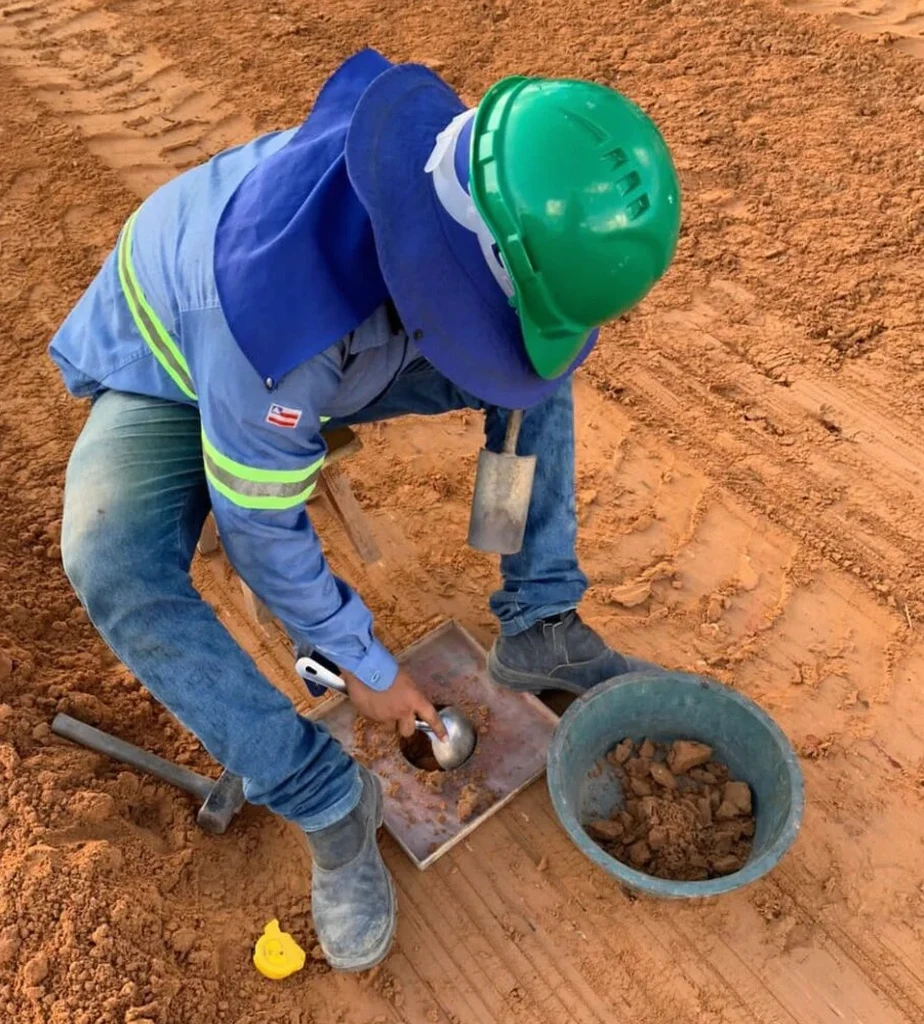
A steel base plate with a funneled jar, a bag of calibrated silica sand, and a small excavation bucket—that’s the kit that shows up on Elk Grove job sites when the question is whether the soil can actually carry the load. The sand cone test, run according to ASTM D1556, measures in-place density directly. For the silty loams and clay lenses that characterize much of the Laguna Creek watershed area, this verification step catches the difference between a lift that looks compacted and one that actually meets the 95 percent relative compaction specified in the geotechnical report. In our experience across projects from Sheldon Road to the Laguna Ridge subdivisions, skipping this check is how pavement failures and foundation settlement start—problems that cost far more to fix than the test itself. The method remains one of the most reliable ways to confirm compaction in granular soils where a nuclear gauge calibration may drift due to moisture variability.
A sand cone test gives you a number you can defend—there is no calibration curve to argue about, just mass and volume measured in the hole.
Methodology and scope
Elk Grove sits on a mix of alluvial deposits from the Cosumnes River system and older Pleistocene terraces, which means the soil profile can shift from sandy silt to fat clay within a single building pad. During the dry summer months—when daytime highs routinely push past 95 degrees Fahrenheit—the surface crusts over and gives a false sense of density if you rely only on proof-rolling. And in winter, when the tule fog settles in and the ground stays damp for weeks, moisture content can swing compaction results by several percentage points. The sand cone method cuts through both extremes because it measures density gravimetrically; there is no electronic component that drifts with temperature or humidity. The test involves excavating a small hole at the compacted surface, weighing every grain of soil removed, then backfilling the cavity with dry sand of known unit weight to determine the volume. From that, we calculate wet density, dry density, and percent compaction against the Proctor maximum—all on-site, so the contractor knows within 15 minutes whether the lift passes or needs rework.
Local considerations
Elk Grove's growth since the early 2000s has turned former pastureland and seasonal wetlands into residential subdivisions at a remarkable pace. What gets built over matters: much of the pre-development terrain east of Highway 99 was agricultural, with decades of irrigation that altered natural moisture patterns and, in some areas, left behind soft organic lenses buried under engineered fill. When compaction testing is skipped or under-sampled on these sites, the consequence usually shows up within the first two rainy seasons—differential settlement cracking driveways, tilting flatwork, or ponding water against foundation walls. The IBC and the local building department require density verification on structural fill, utility trench backfill, and pavement subgrade. Beyond code compliance, the test is the only field method that gives a direct physical measurement of density without relying on nuclear source calibration. For earthwork contractors working near Cosumnes River levees or in the Vineyard area, where fill material can vary truckload to truckload, the sand cone remains the referee test when nuclear gauge results look questionable.
Frequently asked questions
How much does a sand cone density test cost in Elk Grove?
For projects in the Elk Grove area, a single sand cone field density test typically runs between US$110 and US$150 per point, depending on the number of tests performed on the same day and the travel distance to the site. A day rate with multiple tests usually brings the per-point cost down noticeably compared to a single isolated visit.
When is the sand cone method preferred over a nuclear density gauge?
The sand cone is the go-to method whenever the nuclear gauge results need independent validation, or when the soil contains materials that throw off nuclear readings—like high organic content, mica-rich sands, or aggregate with variable iron content. It is also the referee test specified in many Caltrans and local agency standards when there is a dispute about compaction acceptance. On Elk Grove sites with highly variable moisture, the gravimetric approach eliminates the moisture-correction uncertainty that can affect nuclear gauge results.
How long does a sand cone density test take on-site?
From setting up the base plate to reporting the dry density and percent compaction, a single test point takes about 20 to 30 minutes. Most of that time is spent carefully excavating the test hole, recovering all loose soil without disturbing the sides, and oven-drying a representative sample for moisture content. The contractor typically has a pass/fail answer within half an hour, which keeps grading operations moving without long delays.