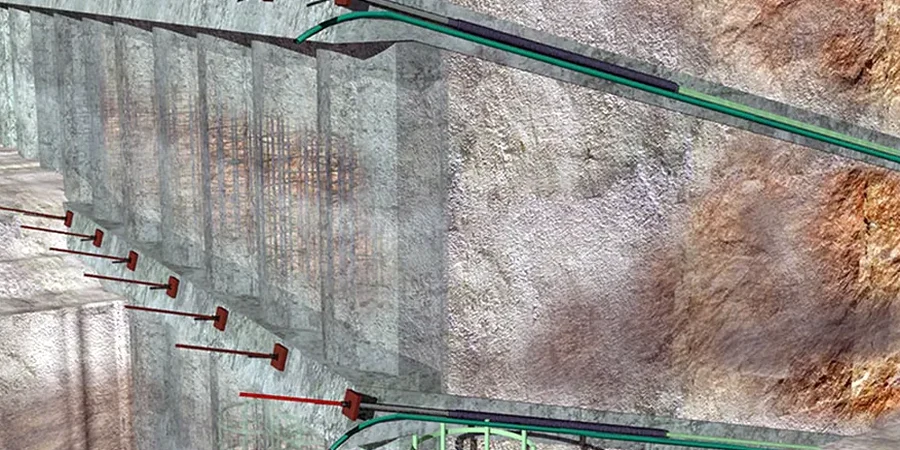
Elk Grove sits at roughly 50 feet above sea level, but the real story is underground. The soils here shift from young alluvial clays to loose sands once you cross the Cosumnes River floodplain. Anchoring a shoring wall or a basement slab in these conditions requires more than just a standard catalog detail. We design active and passive anchors that account for the Sacramento Basin's specific groundwater fluctuations and the area's moderate seismic demand. Before finalizing tendon lengths, the team often correlates data from an adjacent CPT test to map the soft clay lenses that reduce grout-to-ground bond, and we use soil grain size analysis to confirm whether the bearing stratum can handle post-tensioning without excessive creep. The design life for permanent anchors here targets 75 years with double-corrosion protection, matching Caltrans and PTI recommendations for the Central Valley's seasonal wet-dry cycles.
We don't design anchors for textbook soil. We design them for the Cosumnes River alluvium — where the clay behaves like plastic one month and brittle the next.
Local ground factors
We reviewed a shoring failure off Laguna Boulevard where the contractor installed a row of passive anchors without verifying the soil's liquid limit. The winter rains saturated the clay, the Atterberg limits showed a plasticity index over 25, and the grout bond failed progressively because the soil shear strength dropped below the assumed 1,500 psf. It took two weeks of re-design and supplemental tiebacks to stabilize the 18-foot cut. In Elk Grove, the biggest risk is assuming uniform soil. The stratigraphy here includes discontinuous sand stringers that can cause grout loss during installation. If you don't catch those with a preliminary SPT drilling program, you'll see a pressure drop during tremie injection and end up with an under-reamed fixed length. We mitigate this by requiring pre-production verification tests on at least 5% of anchors, and by staging injection in primary and secondary holes when the ground loss exceeds 15% of the theoretical volume.
Frequently asked questions
What is the difference between active and passive anchors?
Active anchors are post-tensioned after grouting to apply a pre-compressive force to the structure, which limits deflections. Passive anchors are not stressed; they develop resistance only when the ground moves and loads the bar. In Elk Grove's soft clays, active systems are preferred for excavations deeper than 12 feet to keep lateral movements under half an inch.
How much does an anchor design package cost for a typical Elk Grove project?
Which load test do you require before lock-off?
For active anchors we follow PTI DC35.1. Performance tests apply a cyclic load up to 133% of the design load, holding each increment for a set time. Proof tests apply a single load cycle to 133% DL. The choice depends on whether the anchor is sacrificial or permanent, and on the variability of the local soil profile.
How do you handle corrosion protection in Elk Grove's soils?
The Cosumnes River basin has a shallow water table with moderate sulfate content. We specify Class I protection for any anchor with a design life over 24 months. This means a corrugated duct filled with cement grout, plus an epoxy coating on the bar or strand and a sealed anchorage cap.
Can you design anchors for a residential basement in Elk Grove?
Yes, we often design passive bar anchors for residential basement retaining walls, especially in subdivisions near Franklin Boulevard where the natural clay is stiff enough to develop bond. We keep the design load under 60 kips and use a simplified proof test procedure to keep the contractor's schedule on track.