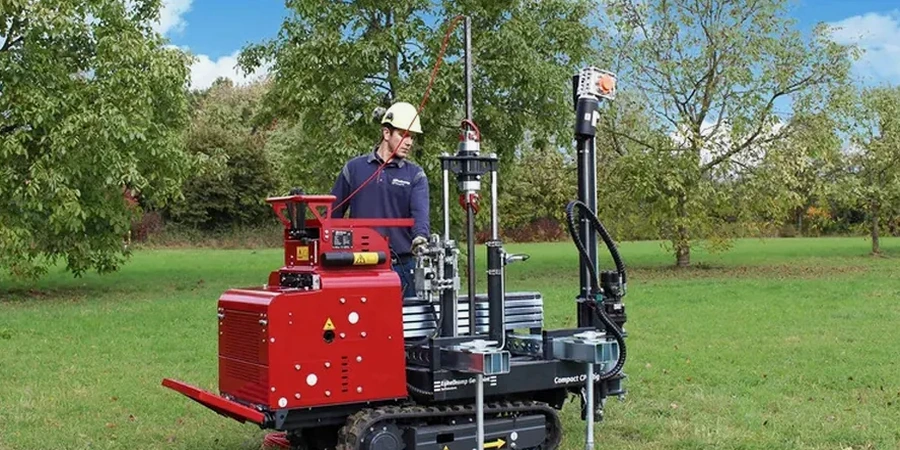
A 20-ton truck with a hydraulic ram pushes a cone-tipped rod into the ground at a constant 2 cm/s. That is a CPT rig at work. In Elk Grove, where the subsurface transitions from stiff Pleistocene terraces into younger basin deposits near the Cosumnes River, this continuous push delivers a high-resolution profile that standard SPT drilling cannot match. The cone measures tip resistance and sleeve friction every 2 cm, logging soil behavior type without bringing a single sample to the surface. For sites near the Laguna Creek corridor or the expanding industrial parks east of Highway 99, the liquefaction potential of loose saturated sands demands this level of detail. We pair it with seismic microzonation data to refine site class assignments per ASCE 7-22, because the difference between Site Class D and E in Elk Grove can swing foundation costs substantially.
Continuous CPT soundings in Elk Grove basin deposits identify thin liquefiable seams that standard SPT would miss entirely.
Local ground factors
Elk Grove grew fast. From a rural town of 60,000 in 2000 to over 178,000 today, the building boom pushed into areas once mapped only for agriculture. Much of the older city core sits on competent terrace deposits, but the newer subdivisions south of Whitelock Parkway encroach on Holocene alluvium with documented liquefaction susceptibility. The 2014 South Napa earthquake reminded everyone in the Central Valley that distant seismic events can shake soft ground hard. CPT-based liquefaction triggering analysis, using the Robertson method or the Boulanger & Idriss procedure, quantifies the factor of safety against liquefaction at each depth. We run dissipation tests at critical layers to measure pore pressure decay, which tells us how fast the soil can drain excess pressure during shaking. For sites where CPT data flags a high risk, stone columns become a viable ground improvement solution to densify the loose zones before construction begins.
Frequently asked questions
How much does a CPT test cost in Elk Grove?
Do you need a drill rig or boring for CPT work?
No. The CPT truck pushes the cone directly from the surface. No cuttings, no drilling fluid, no soil samples. That means a cleaner site and no soil disposal cost, which is a big advantage in developed areas of Elk Grove where access and cleanliness matter.
What depth can a CPT reach in Elk Grove soils?
In the dense terrace deposits east of Highway 99, we typically stop between 15 and 20 m when cone resistance exceeds the rig capacity. In the softer basin deposits west of I-5, we can reach 25 to 30 m. We monitor rod friction and adjust push speed to avoid rod buckling.
Can CPT data replace a boring log for a building permit?
In many cases, yes. The City of Elk Grove Building Department accepts CPT logs as part of a geotechnical report, provided the engineer correlates the CPT soil behavior type to USCS classifications and the report addresses bearing capacity and settlement. We still recommend at least one soil sample from an SPT borehole for confirmation of soil classification when the site has variable fill history.
How fast do you deliver the CPT report?
Data is processed on site. We send the digital log file the same day. The engineering interpretation report with liquefaction analysis, if required, is delivered within 3 business days. We can expedite to 24 hours for urgent foundation redesigns.