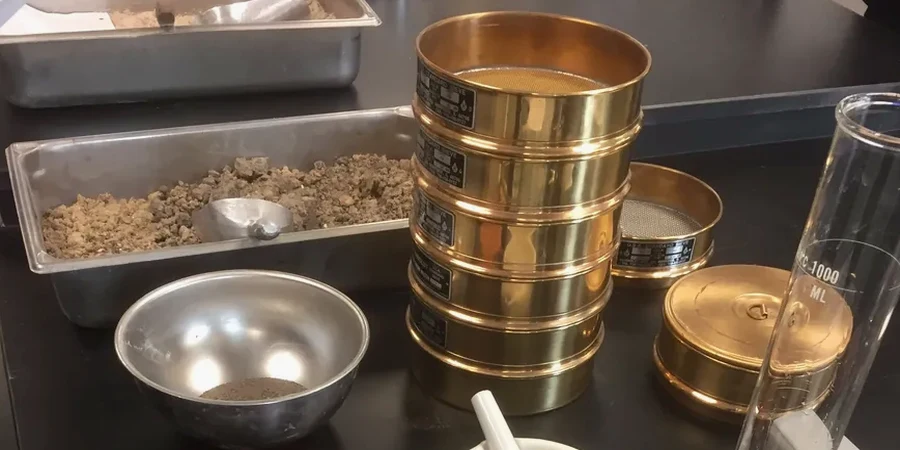
The thick alluvial soils of the Sacramento Valley floor define construction conditions in Elk Grove. What you see at the surface rarely tells the whole story: silty lenses, clay layers and sand pockets alternate in ways that directly affect drainage design, frost protection and bearing capacity. The grain size analysis with sieve and hydrometer provides the full distribution curve, from gravel down to the clay fraction below 0.075 mm. Without that curve, a USCS classification is just an assumption. We run the complete ASTM D6913 and D7928 procedure in our ISO 17025 accredited laboratory, delivering results that engineers can use directly for filter design, compaction control and material selection. In projects near the Cosumnes River floodplain, where groundwater fluctuates seasonally, in-situ permeability testing often complements the gradation data to validate drainage models.
A complete gradation curve is the difference between knowing your soil and guessing your foundation.
Local ground factors
In Elk Grove, we frequently encounter old agricultural parcels where decades of irrigation have washed the fines downward, leaving a surface crust that looks competent but sits over looser, finer material. A gradation curve based only on shallow samples misses that profile completely. The hydrometer portion is the part most often skipped by cheaper labs because it requires 24-hour sedimentation readings, but it is exactly the part that catches the clay fraction responsible for swelling potential and slow drainage. Missing that 5% clay band can mean the difference between an SM and an SC classification, with very different implications for subgrade stability under Elk Grove’s seasonal wet-dry cycles. We recommend sampling at multiple depths whenever the project involves retaining structures or pavements with design lives exceeding 20 years.
Frequently asked questions
What does the grain size analysis cost in Elk Grove?
How long does it take to get the results?
Standard turnaround is three to five business days. The hydrometer sedimentation reading alone requires a minimum of 24 hours per ASTM D7928. We can accommodate rush requests when project schedules demand it.
Do you need the hydrometer test if I only care about gravel and sand?
If you only need the coarse fraction, a sieve analysis per ASTM D6913 is sufficient. However, if the material contains more than 5% fines by visual estimate, skipping the hydrometer means you lose the clay-versus-silt distinction, which can misclassify the soil and lead to poor subgrade or backfill decisions.
What sample size do you require?
For materials with a maximum particle size under 4.75 mm (No. 4), 500 grams is typically enough. If the soil contains gravel up to 19 mm, we need at least 5 kg. We can advise on the exact mass once we know the project location and soil type.
Can you test recycled aggregate or crushed concrete?
Yes. We run gradation on recycled materials following the same ASTM procedures. We note any cementitious fines in the report because they can hydrate during the wash sieve and skew the fines percentage if not handled correctly.