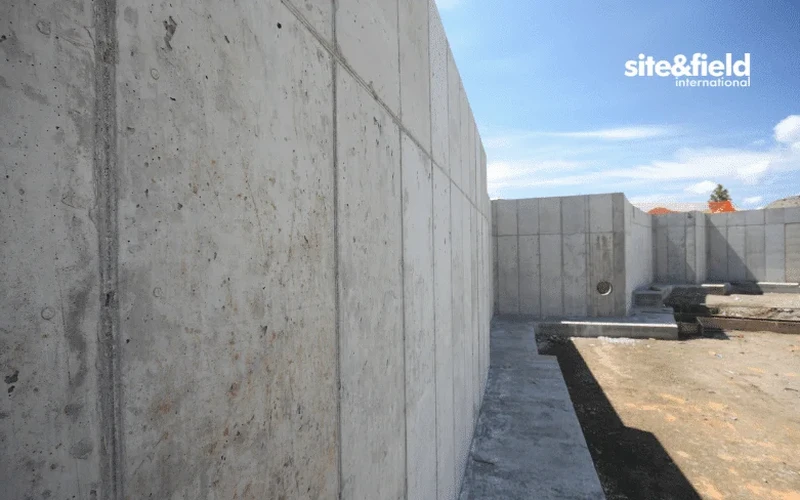
A common misstep we see in Elk Grove is treating a retaining wall as a simple landscape feature instead of a load-bearing structure that must resist lateral earth pressure for decades. The flat terrain near Laguna Creek can deceive contractors into underestimating hydrostatic buildup behind the wall, while the clay-rich soils east of Highway 99 expand and contract enough to crack an unreinforced stem wall within two wet-dry cycles. When the scope shifts from a low garden terrace to a cut that supports a driveway or a sloped building pad, the design must transition from empirical rules to a full geotechnical analysis that accounts for backfill properties, surcharge from adjacent footings, and the site-specific seismic coefficient required by ASCE 7. Before committing to excavation geometry, we often recommend a test pit investigation to log the stratigraphy at the wall alignment, because what looks like uniform topsoil from the surface frequently reveals interbedded lenses of sand and silt that govern drainage design and passive resistance at the toe.
A retaining wall in Elk Grove must manage both seasonal soil expansion and the 0.25g short-period spectral acceleration that governs seismic earth pressure — ignoring either one leads to a serviceability failure within the first five years.
Local ground factors
The contrast between the established Sheffield neighborhood and newer subdivisions south of Whitelock Parkway illustrates how soil variability drives wall risk. Sheffield sits on stiff, desiccated clay that can hold a near-vertical cut for months during summer, tricking some builders into thinking reinforcement is optional; the same clay swells 10 percent by volume after a wet December, generating enough lateral thrust to tilt an undersized gravity wall. South of Whitelock, the profile often includes a loose silty sand layer at 3 to 6 feet depth — excellent for drainage but terrible for basal sliding stability unless the foundation key penetrates into competent material. We address this by pairing a slope stability model with a transient seepage analysis, because a rain-on-snow event in the Sierra foothills can push the Cosumnes groundwater up by several feet in a single week, saturating the backfill and doubling the active pressure behind the wall.
Frequently asked questions
How much does a retaining wall design cost in Elk Grove?
When is a building permit required for a retaining wall in Elk Grove?
The City of Elk Grove requires a permit for any retaining wall over 3 feet in height measured from the bottom of the footing to the top of the wall, or any wall supporting a surcharge such as a driveway or structure. Walls over 6 feet require engineered calculations and stamped drawings.
What type of retaining wall works best in Elk Grove's expansive clay?
Reinforced cantilever walls with a granular backfill zone extending at least 2 feet behind the stem perform well because the free-draining material reduces lateral swelling pressure. We also specify a positive drainage system with a toe drain and waterproofing on the retained side to keep moisture content stable.
Do you handle both the geotechnical report and the structural wall design?
Yes; we start with the subsurface investigation — typically a combination of test pits or SPT borings — to establish allowable bearing pressure and backfill parameters, then proceed directly into the wall geometry, reinforcement detailing, and global stability modeling. This single-team approach avoids the information gaps that occur when the geotech and structural portions are done by separate firms.
How long does the design process take for a typical residential wall?
A standard 5- to 8-foot retaining wall on a single-family lot can be designed and stamped within 10 to 15 business days after the field exploration is complete, assuming the soil conditions are straightforward and no unusual slope stability issues are found.