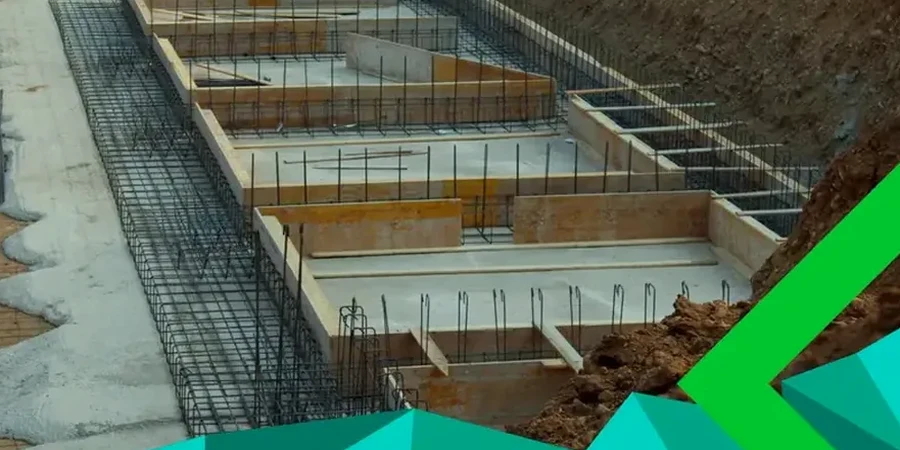
Elk Grove sits on Quaternary alluvial basin fill derived from the Sierra Nevada—mostly interbedded silts, lean clays, and occasional sand lenses. Groundwater can be as shallow as 8 to 12 feet in the western reaches near Franklin, and the upper 4 to 6 feet almost always carry moderate to high expansion potential. That combination—expansive clay over a shallow water table—drives most of the settlement and heave risk we see. A test pit investigation in the Laguna Creek area will typically expose stiff brown clay with hairline desiccation cracks down to about 5 feet, then transition into wetter, softer material below. Our shallow foundation designs start from that stratigraphy: we size footings to keep bearing pressures below the preconsolidation stress of the upper clay and set the bearing depth below the active moisture fluctuation zone. For lightly loaded residential slabs, we often specify a capillary break plus a moisture-conditioned subgrade rather than over-excavation. On the commercial side—think tilt-up warehouses near Grant Line Road—we lean on mat foundations when differential settlement across column lines becomes the governing limit state. The IBC and ASCE 7 seismic provisions apply directly here; Elk Grove is within Seismic Design Category D, so we check bearing capacity reduction under cyclic loading and verify that shallow foundations can resist the overturning moments from a design-level event without excessive rotation.
Allowable bearing pressures in Elk Grove are rarely governed by ultimate failure—it is almost always settlement or heave that controls the design.
How we work
A typical shallow foundation job in Elk Grove starts with a truck-mounted drill rig pushing hollow-stem augers to 20 or 30 feet. We log the cuttings, run pocket penetrometer and Torvane tests on the spoils, and collect Shelby tube samples of the cohesive layers. Back at the lab, the samples go through Atterberg limits, unconfined compression, and one-dimensional consolidation—especially consolidation, because the clay units here are normally consolidated to lightly overconsolidated, and we need the compression index to predict settlement under the footing load. If groundwater is encountered, we install a PVC standpipe and let it stabilize for at least 24 hours before measuring the static level. For mat foundations on soft ground, we supplement the borings with hand-auger or test pit exploration in the upper 5 feet to characterize the active zone directly; that data feeds the heave prediction model. Our design output includes a bearing capacity chart that accounts for the groundwater correction, a settlement curve for the critical column, and a plan sheet showing the recommended bearing depth and any subgrade improvement—usually moisture conditioning plus proof-rolling with a loaded water truck. Where the upper clay is thicker than 8 feet, we model the footing as a rigid plate on an elastic half-space and compare the immediate settlement to the tolerable angular distortion for the structural system. The allowable bearing pressure we land on is typically between 1,500 and 2,500 psf for continuous wall footings, depending on how close the water table is to the bearing elevation.
Local ground factors
The risk profile changes noticeably between the older subdivisions around Elk Grove Boulevard and the newer developments pushing east toward Bradshaw Road. The older lots sit on stiff, desiccated clay that has been drying out for decades; the heave potential is partially exhausted, but the soil is brittle and can crack footings if a tree root pulls moisture from underneath. The newer subdivisions, on the other hand, are built on agricultural land that was flood-irrigated for years—the clay is closer to saturation, and the heave potential is fully intact. Put a lightly loaded slab-on-grade on that saturated clay without a capillary break, and you will see edge lift within two wet seasons. We see it every year. The other risk that gets overlooked is differential settlement where a footing spans across a sand lens; the clay compresses over months, the sand drains and settles almost immediately, and the result is a step crack in the stem wall. Our shallow foundation reports flag those transitions explicitly, and we specify a continuous footing with longitudinal reinforcement when the borings show interbedded sand and clay within the influence zone. Seismic liquefaction is generally not a concern for shallow foundations in Elk Grove proper—the susceptible sands are too deep or discontinuous—but we still run a screening based on the SPT blow counts and the groundwater elevation, just to be sure.
Frequently asked questions
What is the typical allowable bearing pressure for a shallow foundation in Elk Grove?
For continuous wall footings bearing at 24 inches below grade in stiff to very stiff clay, we commonly recommend between 1,500 and 2,500 psf. The exact value depends on the groundwater elevation at the time of drilling and the consolidation properties of the clay. We derive it from a bearing capacity equation with a factor of safety of 3, then reduce further if settlement exceeds ¾ inch.
Do I need a mat foundation or can I use spread footings on my Elk Grove site?
Spread footings work well when the soil profile is uniform and the column loads are moderate—think single-story steel frames or wood-framed residential. If the borings show more than ½ inch of differential settlement between adjacent columns, or if the upper clay is thicker than 10 feet and normally consolidated, we typically recommend a mat foundation to bridge the variability and reduce total settlement.
How much does a shallow foundation design cost for a typical Elk Grove project?
How do you handle the expansive clay in Elk Grove?
We set the bearing depth below the active zone—typically 24 to 30 inches—and specify a 4-inch capillary break of clean sand or gravel under all slabs. The subgrade is moisture-conditioned to near optimum and proof-rolled before rebar placement. On sites with extreme expansion potential, we may call for a structurally suspended floor with a ventilated crawl space to decouple the slab from the clay entirely.