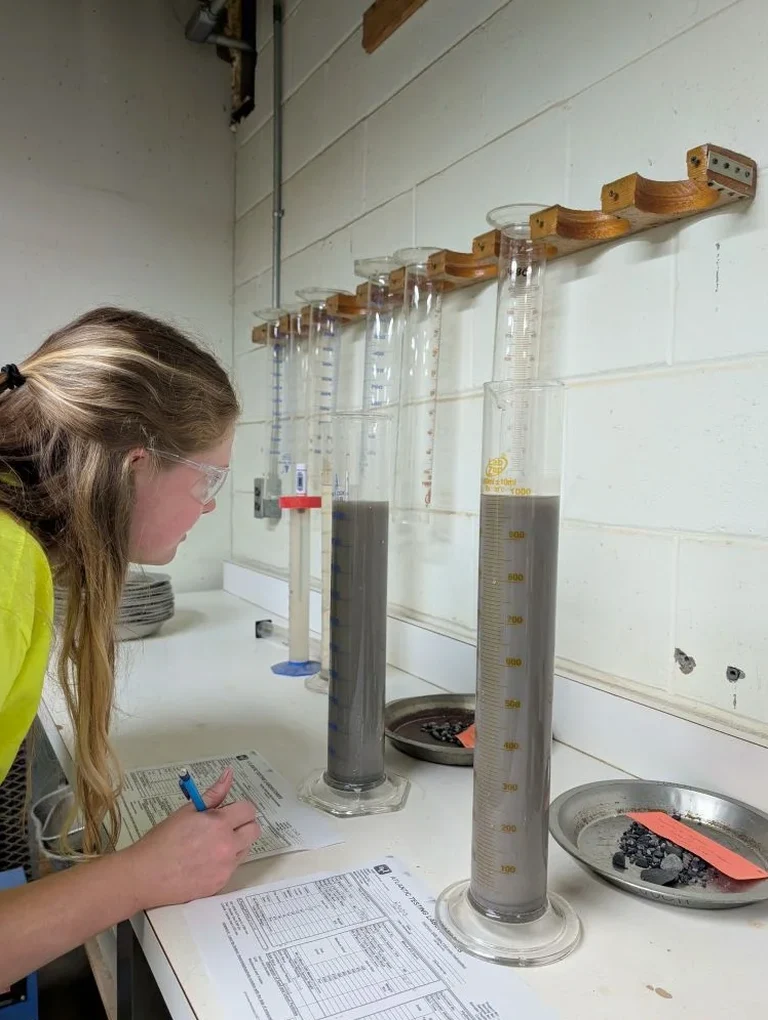
With over 180,000 residents spread across a flat basin roughly 45 feet above sea level, Elk Grove’s infrastructure depends on pavements that can handle both the dry summer heat and the occasional winter saturation of its clayey subgrades. The laboratory CBR test provides the soaked strength value that determines how thick a pavement section really needs to be. Many projects in the Laguna Creek watershed encounter silty clays that lose significant bearing capacity when wet, which makes the soaked CBR value far more telling than any dry reading. We run the procedure strictly under ASTM D1883, compacting specimens at the optimum moisture content obtained from a paired Proctor curve, then soaking them for 96 hours to simulate the worst field conditions. For projects near the Cosumnes River floodplain, this data often triggers a CBR-based road design review that adjusts the structural number before the first truck of aggregate arrives on site.
A soaked CBR below 3 in Elk Grove silty clay means the pavement section must be redesigned — there is no way around it.
How we work
One thing we observe regularly in the Elk Grove area is the marked drop in CBR between material compacted at 95% of modified Proctor and the same soil after full saturation. A silty clay from the eastern part of town might deliver a CBR of 12 in its as-compacted state but slide below 4 after the four-day soak. That gap changes everything: it forces a thicker base course or even a lime-stabilized layer before placing the asphalt. Our laboratory CBR test setup uses a standard loading frame applying 0.05 inches per minute, with readings taken at penetrations of 0.1 and 0.2 inches, and the final value reported as the higher percentage against the standard crushed stone curve. We control compaction energy using a 5.5-pound rammer dropped 18 inches, following the method that matches the expected field compaction effort. Because the Sacramento region has seen rapid residential expansion, developers often need CBR data within a tight turnaround window, and we schedule the 96-hour soak to dovetail with the rest of the geotechnical report timeline so the pavement design chapter does not hold up the permit submission.
Local ground factors
A commercial project near Whitelock Parkway taught us a costly lesson about skipping the laboratory CBR test early in the design phase. The geotechnical report relied on conservative assumed CBR values from a regional table, but the actual subgrade under the parking lot contained lenses of highly plastic clay that swelled during the first winter rains. Within eighteen months, the asphalt surface showed alligator cracking and rutting that exceeded the maintenance budget. A soaked CBR test run on the same clay later returned a value of 2.1 at 95% compaction, well below the 5 that the pavement section had assumed. The fix required full-depth reclamation with cement stabilization, at a cost that dwarfed the original testing budget. When a pavement fails because the subgrade strength was overestimated, the repair costs cascade through the entire cross-section: base course, binder, and wearing surface all have to be rebuilt, and the business disruption adds another layer of financial pain that a simple laboratory CBR test could have prevented.
Frequently asked questions
How much does a laboratory CBR test cost in Elk Grove?
Why is the soaked CBR value more important than the unsoaked one?
The soaked CBR represents the subgrade after prolonged saturation, which is the condition that causes most pavement failures. Elk Grove soils experience seasonal groundwater rise and irrigation infiltration, so a strength reading taken on a dry specimen gives a false sense of security that does not survive the first wet winter.
How long does it take to get results from a laboratory CBR test?
The compaction and penetration testing can be completed in one day, but the mandatory 96-hour soaking period means the full CBR report is typically ready five working days after the sample arrives at the lab. We can coordinate with the pavement designer to release preliminary data earlier if needed.
What CBR value does Caltrans require for residential streets in the Sacramento area?
Caltrans and most Sacramento County agencies expect a minimum soaked CBR of 3 to 5 for residential subgrade, though the exact target depends on the traffic index and the pavement structural section. Values below 3 generally trigger a requirement for subgrade stabilization or a thicker aggregate base, and we document the recommendation in the geotechnical report based on the measured soaked strength.