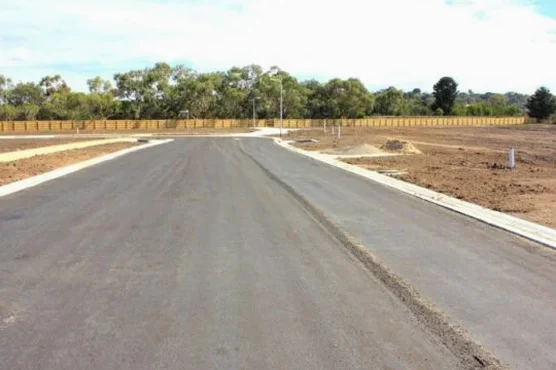
Elk Grove sits at about 45 feet above sea level, on the eastern edge of the Sacramento–San Joaquin Delta. That low elevation means a high water table and plenty of silty, expansive soils. In our lab, we see the same pattern year after year: subgrade support that looks fine in September falls apart by February. Rigid pavement design here has to account for that swing. We rely on CBR road testing to quantify the subgrade strength under soaked conditions, and we cross-check with grain size analysis to confirm fines content. The concrete slab can bridge minor soft spots. But it cannot fix a subgrade that pumps or heaves. That is where the lab data drives the thickness.
In the Delta region, the difference between a 20-year pavement and a 5-year failure often comes down to one soaked CBR test.
Methodology and scope
The contrast between Elk Grove's dry summers and wet winters dictates the entire rigid pavement design. Summer compaction on a bone-dry clay gives a false sense of stiffness. Come December, that same soil swells and loses bearing capacity. We therefore condition all samples to the worst-case moisture scenario per ASTM D2487. Our lab runs flexural strength on concrete beams, not just compressive cylinders, because the modulus of rupture governs slab performance. We also test the coefficient of thermal expansion for the aggregate source—critical in a region that hits 100°F in July and drops near freezing in January. Joint spacing, dowel bar sizing, and load transfer efficiency all flow from these numbers. Typical designs in Elk Grove point to JPCP with 15-foot joint spacing on a 6-inch cement-treated base, but every lot is different. We verify each one.
Local considerations
Elk Grove grew fast in the 1990s and 2000s, pushing residential subdivisions into former pastureland and floodplain soils. Those soils were never engineered for rigid pavement loads. We have pulled cores from failed driveways and parking lots where the concrete was intact but the subgrade had turned to mush. The risk is not just cracking. It is faulting at the joints, pumping of fines, and loss of slab support. In a rigid pavement, once the base erodes, the slab goes into cantilever bending and breaks. A proper rigid pavement design, backed by lab and field data, intercepts that failure chain before it starts. We test the subgrade, we test the base, we test the concrete. No shortcuts.
Applicable standards
ASTM C78 / C78M-21 — Flexural Strength of Concrete (Simple Beam with Third-Point Loading), ASTM D1883-21 — California Bearing Ratio (CBR) of Laboratory-Compacted Soils, ASTM D2487-17e1 — Classification of Soils for Engineering Purposes (Unified Soil Classification System), ACPA Guide to Concrete Overlays (2020), AASHTO Guide for Design of Pavement Structures (1993, with supplements)
Frequently asked questions
What is the estimated cost range for rigid pavement design and lab testing for a typical Elk Grove commercial lot?
For a standard commercial lot in Elk Grove, the combined lab testing and design support package typically falls between US$1,960 and US$5,410. The spread depends on the number of borings, the concrete mix iterations, and whether we need to run flexural beam tests or just compressive strength checks.
How do you determine the modulus of subgrade reaction (k-value) for rigid pavement design in this area?
We start with a soaked CBR test on undisturbed or recompacted samples from the subgrade elevation. For the silty and clayey soils common in Elk Grove, we apply the standard CBR-to-k correlation, adjusting for the seasonal moisture variation we document in the lab. If the project is large, we back up the CBR with plate load test data or R-value testing to refine the k-value.
Do you recommend doweled or undoweled joints for rigid pavements in Elk Grove?
It depends on traffic and slab thickness. For residential driveways and light-duty parking, undoweled JPCP with short joint spacing works fine. For commercial lots, truck docks, and arterial streets, we recommend doweled joints with 1.25-inch smooth bars to maintain load transfer. The lab data on the base support and the concrete's modulus of rupture drives that decision.