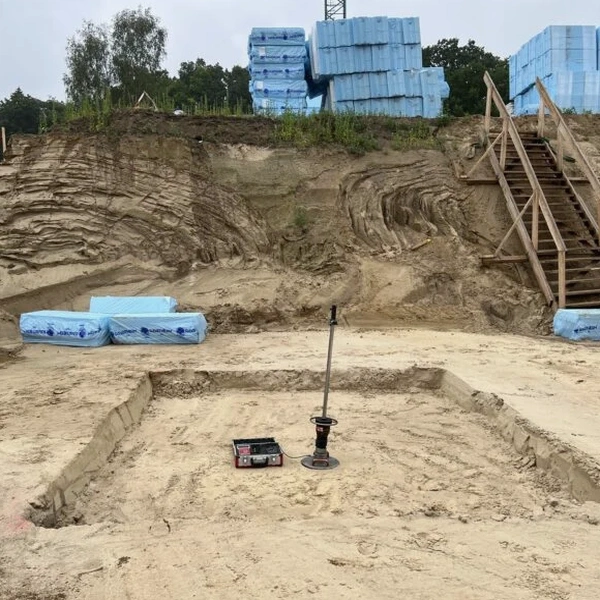
Elk Grove sits on the eastern edge of the Sacramento Valley, where Pleistocene-age alluvial fans from the Sierra Nevada foothills transition into the fine-grained floodplain deposits of the Laguna Creek watershed. These soils — largely silty sands and lean clays of the Modesto and Riverbank formations — can lose significant bearing capacity if not compacted to specification, and the difference between 92% and 95% relative compaction often determines whether a slab-on-grade performs for 30 years or starts cracking in five. The Proctor test establishes the moisture-density relationship that every Elk Grove earthwork contractor relies on to meet city and county grading code requirements, particularly in subdivisions east of Highway 99 where expansive near-surface clays are common. Our laboratory runs both Standard Proctor (ASTM D698) and Modified Proctor (ASTM D1557) on site-specific borrow and structural fill materials, providing the target dry density and optimum moisture content before compaction crews ever mobilize to the lot. For projects where fill placement is ongoing, we pair the Proctor benchmark with sand cone density testing to verify achieved compaction against the lab curve, and when subgrade soils prove problematic we recommend grain-size analysis to identify gradation issues that may require blending or import of select fill.
A one-percent deviation from optimum moisture can reduce dry density by 3 to 5 pcf — enough to drop a fill lift below the 95% relative compaction threshold required by Elk Grove grading ordinances.